Showing posts with label alum. Show all posts

Wednesday, 16 May 2012

Preparing and testing the colours

Before the gouaches and watercolours can be used for marbling, they must be diluted, and mixed with Ox-gall. However, if you are using water-based marbling paint , you do not need to dilute them, but simply mix in gall.

1-take a small amount of the gouache/watercolour, and squeeze it into the cup.
2- add in a few drops of gall. Six or so drops is a good starting point, but some colours need more gall than others.

steps 1 & 2
3- mix well with a brush
4- add in water to fill the cup, stirring all the while.

Now, Preparing the colours requires some degree of skill. Some pigmnts ( like the cadmiums and some earths) are dense in nature, and so need to be diluted more. Others, like the platato colours, are light by nature, and therefore need less gall.

Once the colours are mixed, you can begin testing them.

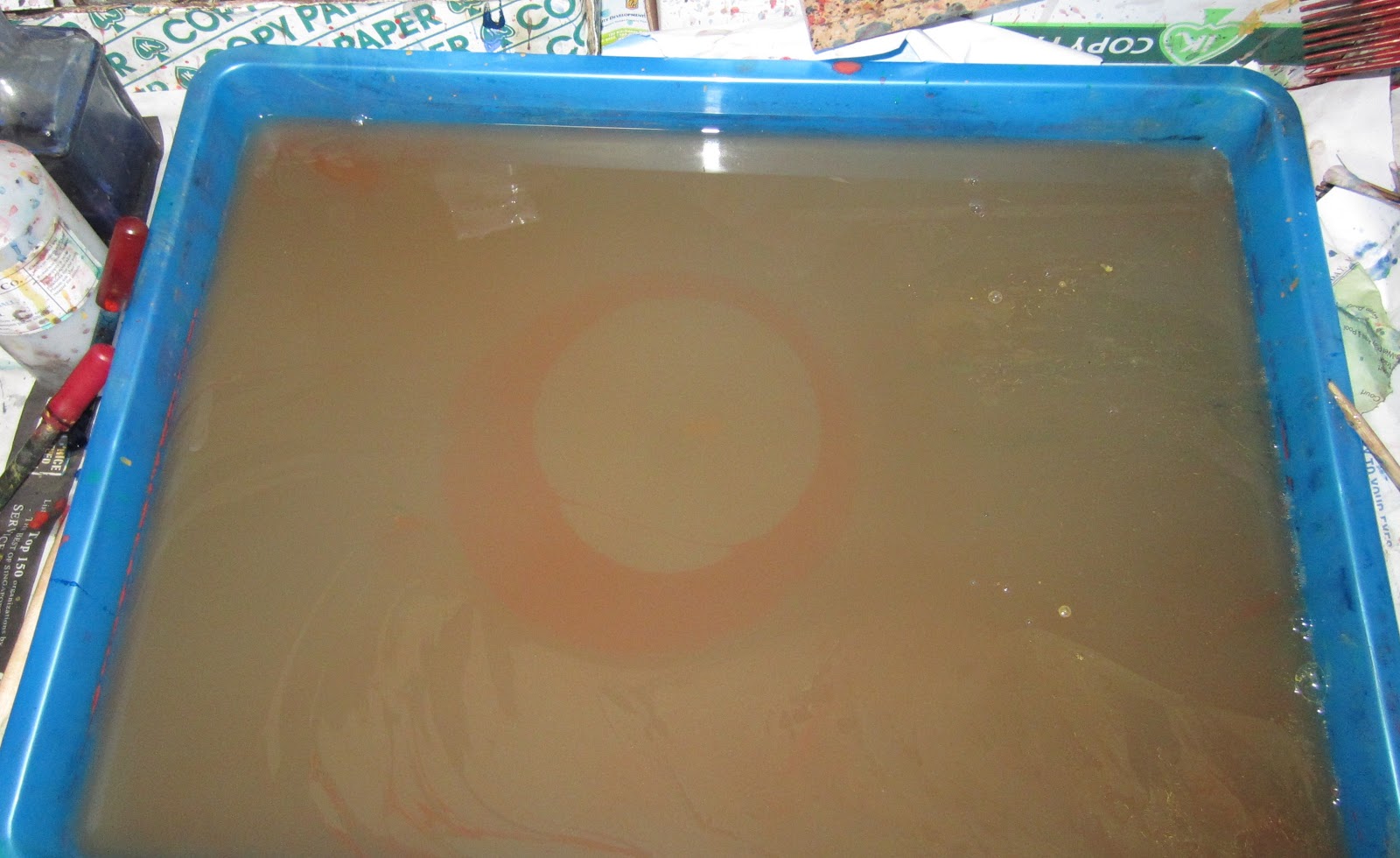
Firstly, "skim "the size. To do this, drag a piece of paper or a slat of wood over the size. This is done to remove the "skin" on the size, ( much like a soup), which will stop the colours from spreading.

Then drop on your first colour. It should spread like this; to a circle about 2-3 inches across

1st colour
The second color you intend to use must have a little more gall than in the first so that it can spread out over the first. 
2nd colour on
Do the same with your third and fourth colours. [if you have them] In either case, the colour should not sink, but spread over the colour previously put on.  Keep this order in mind whan you apply the colours during marbling. 

                                              3rd colour on                                 4th colour on
 There is no fixed amount of gall to be used. Some colours require more than others. However, If you are using HUGE amonts of gall, to no effect, something is amiss. Either
1- Your colours are too thick  - Try watering them down
2- The gall is weak. This is a common problem with gall meant for watercolour. - switch to a diffent brand, or one from a marbling supplier.

 If, however, the colours do not spread much, and you have found that the gall is not the culprit, then there is something wrong with the size.
 3- The size is too thick - Add some water to thin it down
 4- Size too cold- add some hot water
 5- Did you skim the size?

Sometimes, you may find that the colours look grainy on the size. Not to worry, add some drops of alcohol.

Monday, 30 April 2012

paper

The paper used here is very much a matter of what you have available, what you intend to make out of the finished product, and what you can afford. I prefer machine- made watercolour or sketching paper, for it is cheap enough , but thick enough to survive the wetting.  Expensive handmade papers are for most purposes,  a waste of money here,  unless the use that you intend to put the marbled paper to forces you to utilise this paper.  The reason for this is because expensive sheets may be spoilt by an errant air- bubble or similar fault.
Another thing the marbler must take note of is the fact that some of the papers on the market are heavily buffered against acid. This is a disadvantage to the marbler, for the alum is mildly  acidic in nature , and the buffered paper would neutralise the alum, and as a result, render it useless.
Because of the alum, marbled paper is, naturally, a bit acidic, but let that not worry you, because most purposes so not require such a level of acid-freeness, and besides, I posses samples of marbled paper from 1851, which are as clean and bright as ever, and the book to which they are attached shows no sign of deterioration.
Also, avoid the shiny or overly sized papers, for, they  would reject the alum, and the colours.
However, I can only do so much. You must experiment  to find the best sort.


The paints

The paints used for marbling fall mainly into two categories, watercolours/gouaches and acryllics. Acrylics are more often used today, as they are waterproof , and can be used to marble fabric. However, watercolours are simpler to use, and give a wider range of patterns .
 Some paints work better for marbling than others. For example, one paint may spread uncontrollabaly, another would refuse to spread at all, and some others may be very pale.
 Generaly, the best paints to use are artist's watercolours ( as opposed to student's watercolours), or gouaches ( Gouache is simply a opaque watercolour) . These paints give more consistent results, and are less likely to fade. Brands like Windsor & Newton's are of the highest quality, but are very expensive. The next best type would be Daler-Rowney's designer's gouache . This paint is quite cheap, and produces decent results.

 However, even within the same brand, diffrent pigments behave in very diffrent ways. Some spread like mad, and dominate the paper ( like phlatato blue), others are heavy and dense, refusing to spread  much. To make matters even more confusing, companies may change the paint formula, thus making a previously good paint useless.

To that end, I shall furnish you with a list of colours that have been known to work. The following list is but a guide, and more colours can be introduced to please the fancy

yellows
Yellow Ochere

Reds
 red earth
cadmium red
alizarin crimson

blues
prussian blue
phlatato blue
indigo
ultramarine

greens
A mixture of phlatato blue and yell. ochere
phlatato green

Black
lampblack,
ivory black
 note; a little prussian blue phlatato blue or indigo can be mixed into the black to make it denser
Brown
burnt umber
burnt ocher
umber

 Other colours, like orange and purple, can be created by mixing the appopriate colours.

Tuesday, 17 April 2012

Alum

alum, in powder ( left) and lump ( right) form
Alum is the third most important substance in marbling, after the gall and the size. It makes the colours adhere to the paper.
 Marbling on tragacanth does not requore alum  but the paper must be dampened slighly to accept the colour. The reasons behind this I have not been able to find out,( but it might, historicaly have something to do with the fact that the paper used being more absorbent). However, marbling on Carrageen requires the substance to be dissolved in water, and sponged on the paper.  The process imparts some degree of acidity to the paper .  As a result, some binders tend to avoid them. However, for odinary uses, the acidity is negligable.
There are two kinds of alum , potash alum (potassium aluminium sulfate), or just plain alum ( aluminium sulafte). Both work well.

Take a heaped tablespoon of powdered alum , and dissolve it in a cup of hot water. Stir to dissolve. ( this has a tendency to heat up the water, so be careful) .
Now, take the sheets of paper you intend to marble, and mark the side you do not want to marble with a pencil. This helps you distinguish which side to lay on the size.

Soak a sponge in alum, and apply it to the side that is not marked. Lay it flat to dry.

The paper can be marbled when it is dry, or slightly moist.